After three weeks away from the UK, my first Friday night out after work started exceptionally well at:
The Cockpit, EC4V 5BY
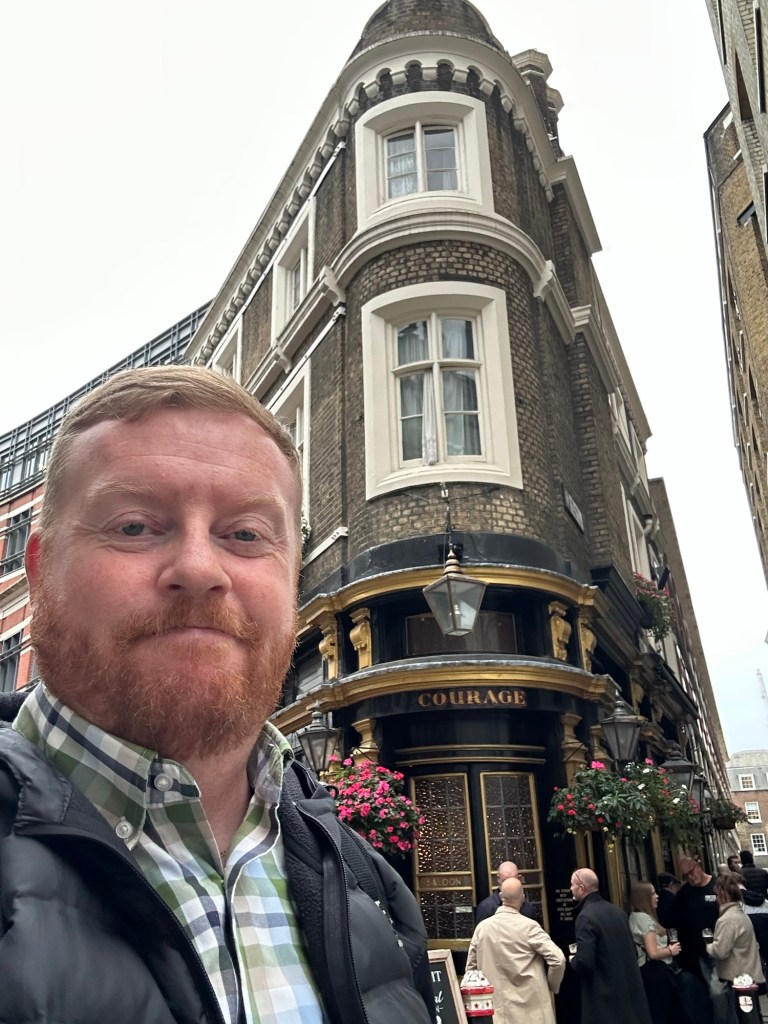
I went with a pint of Five Points XPA 4% here.
There has been a pub or inn on this site since at least the 16th century, and the area used to be part of the Blackfriars monastery. The name ‘Cockpit’ refers to its alleged former use as a venue for cockfighting, a practice that was legal in England until it was banned 1849. After cockfighting was outlawed, the pub was re-named The Three Castles for some time, but later reverted back to the original name.
The current building is dated to around 1860. It is a Grade II listed building, triangular in plan, with a rounded corner. Notable features include leaded windows, decorative window surrounds, and a gallery (or balcony) above the main bar area.
There are claims that William Shakespeare bought a house nearby (in Ireland Yard) in 1613 for £140, and so the pub is often associated with that Shakespeare connection, but precise documentary evidence linking the current pub building with Shakespeare’s house is uncertain.
It remains a working pub with traditional features: warm décor, original architectural touches, gallery, high ceilings. The pub is known for having good ales, a friendly atmosphere, and being open even on Sundays (unlike many City pubs).
For me the most important thing is that it feels like a proper old London pub – unspoiled and unpretentious, and still displaying some old Courage Brewery signs and memorabilia. Pubs like this are sadly rare in London these days.
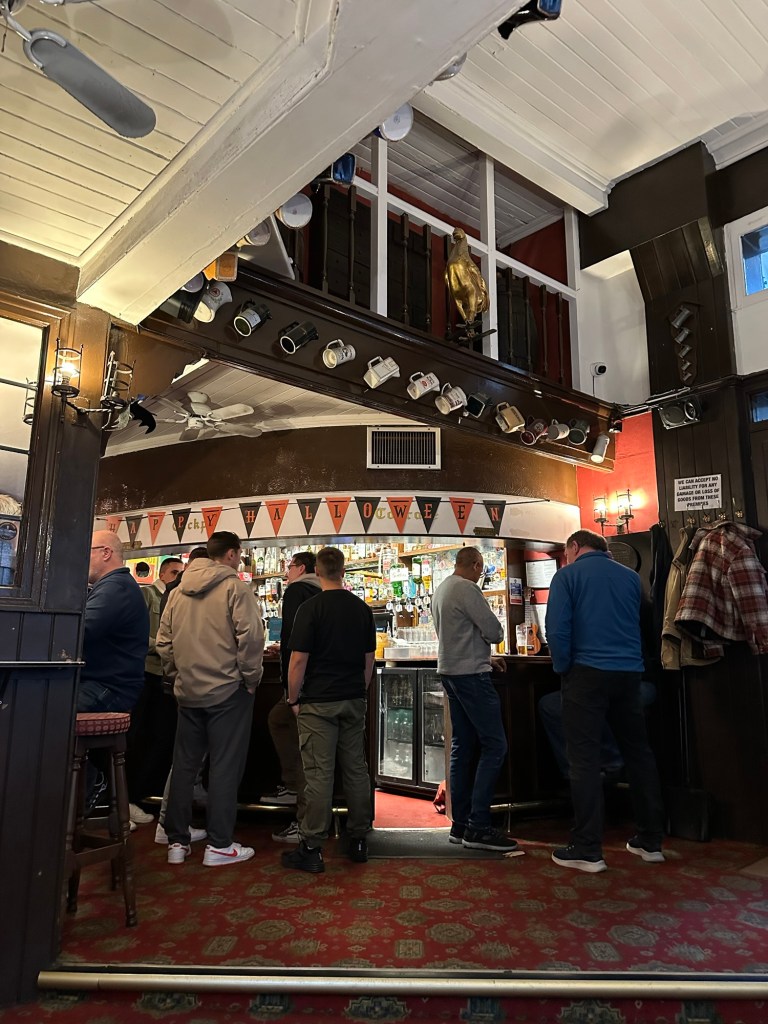
After a short walk, my next stop was:
The Black Friar, EC4V 4EG

I had a Bass (4.4%) here.
This famous pub, noted for its Arts & Crafts / Art Nouveau style, stands on the site of a former medieval Dominican friary (Blackfriars) which existed from the late 13th century until the Dissolution of the Monasteries in the 16th century.
The building was erected around 1875 (originally) on the friary site, but a major remodelling took place in about 1905 (with further changes later between 1917 and 1925) led by architect Herbert Fuller-Clark, with decorative work by artists such as Henry Poole and Frederick T. Callcott.
Although hard to believe now, in the 1960s there were threats to demolish it, but it was saved thanks to a public campaign, notably involving Sir John Betjeman.
The building is wedge-shaped (a triangular corner site due to the proximity of roads and the railway from Blackfriars station) which gives it a distinctive profile. Exterior features include mosaic fascias, sculpted stone figures, ornate balconies, decorative ironwork, and a “guardian black friar” figure above the front. Inside, there is a very rich decorative scheme including marble, alabaster, wood carvings, and mosaics. There are bronze panels and bas-reliefs of friars doing various daily or playful things (eating, singing carols, collecting fish for meatless Friday, etc.).
One of the most famous features is the small barrel-vaulted room at the back (added around 1917-21) under the railway, richly adorned, with humorous and whimsical reliefs (nursery rhymes, Aesop’s fables etc.).

Today the pub is operated by Nicholson’s Pubs, known for preserving historic pubs and offering classic British pub food and drink. A recent refurbishment (2025) has restored historical features and upgraded furnishing indoors and outdoors, and improve facilities while keeping the heritage and style intact.
Another short walk took me to:
The Crown & Sugar Loaf, EC4Y 8DT

This is a Samuel Smith’s pub with no cask beer, so I had a half of their Extra Stout 4.5%.
Standing just along from St. Bride’s Church, The Crown and Sugar Loaf occupies a site steeped in Fleet Street’s long history of printing, journalism, and convivial drinking. The name itself dates back to the 18th century, recalling the emblem of the Sugar Loaf, a traditional measure of refined sugar used by grocers and merchants, often paired with a royal “Crown” to signal quality and trade respectability.
The current building dates largely from the early Victorian period (mid-19th century), when Fleet Street’s transformation into the epicentre of London’s newspaper world brought with it a flourishing of ornate public houses. The façade features stucco ornamentation, tall windows, and traditional gilded signage, typical of Victorian tavern design. Inside, the pub retains its polished mahogany bar, etched mirrors, and decorative ceiling mouldings, echoing the confident craftsmanship of the age.
For decades, The Crown and Sugar Loaf served as a favourite haunt of printers, compositors, and clerks from nearby publishing houses and newspaper offices. Its position near the Daily Telegraph’s former headquarters made it a convenient meeting spot for the press fraternity.
Almost next door is:
The Old Bell Tavern, EC4Y 1DH

Here I had a half of Timothy Taylor’s Landlord Dark 4.3%.
This historic tavern, one of London’s oldest surviving pubs, stands on the celebrated Fleet Street, long known as the heart of Britain’s newspaper industry. The building occupies a site that has been associated with hospitality and craftsmanship since the late 17th century, when it was built by Sir Christopher Wren to serve the stonemasons and builders working on the nearby St. Bride’s Church following the Great Fire of London (1666).
The pub dates from around 1670, and though it has been altered and refurbished over the centuries, it retains much of its original 17th-century character, with timber framing, panelled interiors, and leaded windows. The Old Bell has long been a meeting place for printers, journalists, and editors, reflecting Fleet Street’s vibrant press heritage. Many who worked at the nearby newspaper offices – The Times, Daily Telegraph, and others – were regulars here, giving the pub a rich association with London’s literary and journalistic life.
Architecturally, the building’s warm brick façade and traditional frontage evoke the modest but enduring style of post-Fire reconstruction. Inside, the atmosphere remains cosy and traditional, with dark wood panelling, open fireplaces, and period fixtures that hint at centuries of conviviality.
In the 20th century, the Old Bell continued to thrive even as Fleet Street’s newspaper presses fell silent. It became recognized not only for its historical significance but also as a symbol of continuity amid change in this storied part of London.
Today, the tavern is operated by Nicholson’s Pubs, who maintain its heritage features while offering a menu of classic British ales, pies, and pub fare. The Old Bell remains a cherished stop for visitors exploring St. Bride’s Church, Fleet Street, and the enduring traditions of London’s pub culture – a living relic of Wren’s London, still ringing true after more than 350 years.
A short walk up Fleet Street took me to:
Ye Olde Cheshire Cheese, EC4A 2BP
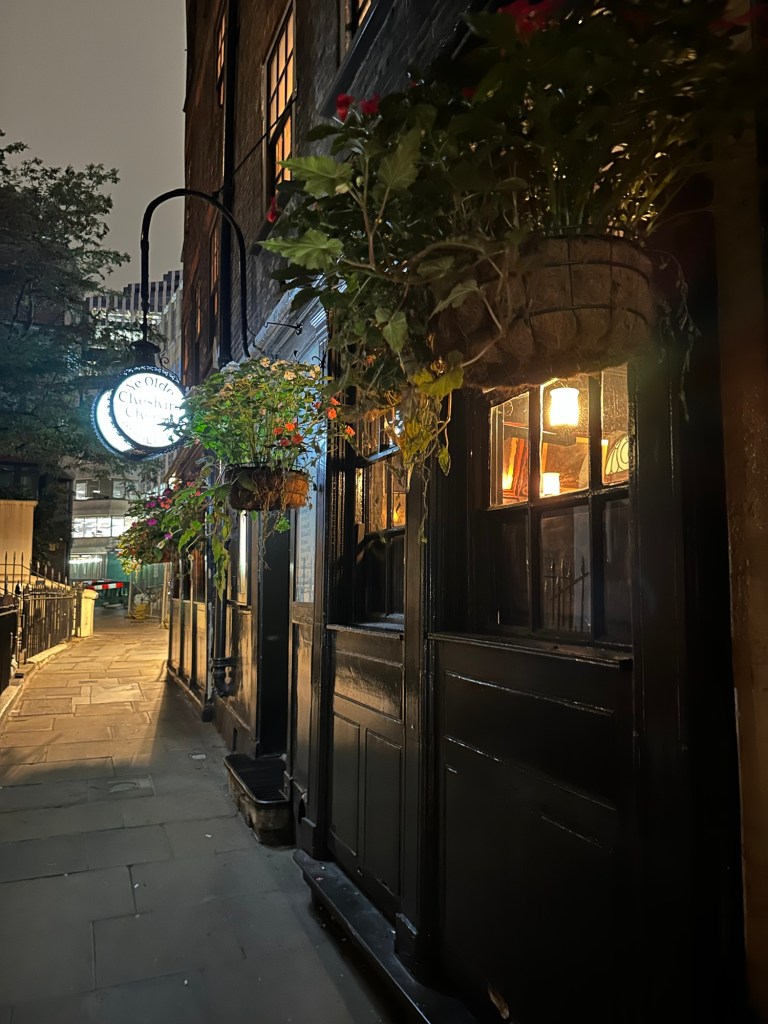
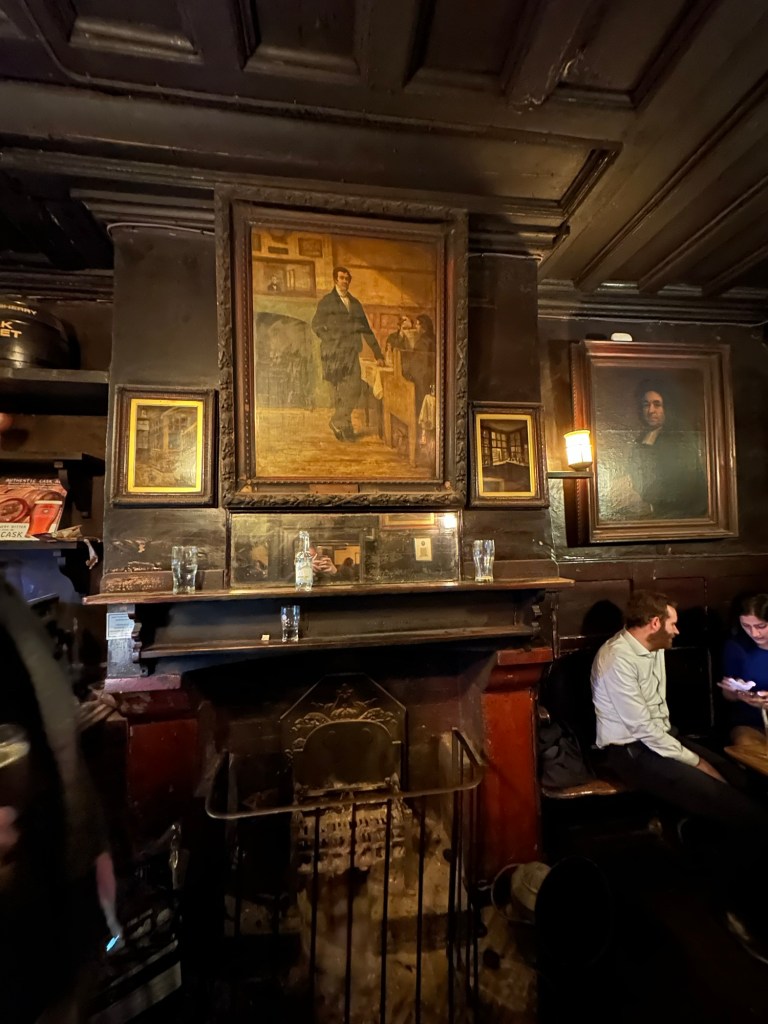
This is also a Samuel Smith’s pub. Although they did have Old Brewery Bitter on, I stuck to their Extra Stout 4.5%.
Tucked away down a narrow alley off Fleet Street, Ye Olde Cheshire Cheese is one of London’s most famous and atmospheric historic pubs. Rebuilt shortly after the Great Fire of London in 1666, it occupies a site that had hosted taverns since at least 1538, making it one of the city’s oldest surviving drinking establishments. The sign detailing the various reigns of monarchs since the rebuild has recently been updated to include King Charles III.
The current building, dating from around 1667, retains its dark timber panelling, sawdust-strewn floors, low-beamed ceilings, and warren-like layout of snug rooms and cellars, some of which are said to pre-date the Great Fire. The sense of stepping back in time is palpable; the interior lighting remains deliberately subdued, preserving the pub’s centuries-old character.
The Cheshire Cheese became a celebrated haunt for writers, journalists, and literary figures – among them Samuel Johnson, Charles Dickens, Mark Twain, and G.K. Chesterton. It has long been associated with Fleet Street’s press culture and with the enduring image of London as a city of letters and conviviality.
Now owned by Samuel Smith’s Brewery, the pub continues to serve traditional English fare in surroundings largely unchanged since the 17th century. To descend its creaking stairs or sit beside its open hearths is to experience a living piece of London’s history – a rare survivor of the city’s post-Fire rebuilding and one of its most beloved literary landmarks.
A bit more walking along Fleet Street and behind the Royal Courts of Justice took me to:
The Seven Stars, WC2A 2JB

Here I chose Adnams Southwold Bitter 3.7%.
Hidden behind the Royal Courts of Justice on Carey Street, The Seven Stars is one of London’s most atmospheric and historically significant taverns – a rare pre–Great Fire of London survivor. Built around 1602, this timber-fronted pub predates the 1666 fire and is one of only a handful of buildings in central London to do so. Its name, “The Seven Stars,” is thought to refer to the Seven Provinces of the Low Countries, reflecting the area’s connections to trade and law during the early Stuart era.
From its crooked exterior with leaded windows and original gables to its snug wood-panelled interior, the pub exudes an old-world charm untouched by time. Over the centuries, it has served lawyers, clerks, and judges from the nearby Inns of Court, who have made it their unofficial common room for more than four hundred years.
Inside, the atmosphere remains distinctly traditional – low ceilings, flagstone floors, and mirrors etched with historic lettering. The pub is also renowned for its independent spirit, standing outside large brewery ownership and retaining a sense of personal stewardship.
Today, The Seven Stars continues to serve a loyal mix of legal professionals, locals, and history enthusiasts, offering real ale, good food, and a glimpse of London before the Great Fire — a true survivor in every sense.
 Neil's Real Ale & Pubs Page
Leave a comment